
Lanchester Strategy Calculator|Free Simulation of the First and Second Laws
This free web app allows you to easily calculate the famous Lanchester Strategy used in business strategy.
Simply enter the "force strength" and "weapon performance" of your side and the enemy to simulate which side has the advantage.
In business management, force strength can represent "capital power, organizational strength, sales capability, or number of employees," while weapon performance can represent "technology, product quality, or brand strength."
Use Lanchester Strategy to analyze how to outperform competing companies.
Use Lanchester Strategy to calculate how much force strength (capital power) and weapon performance (quality) you need in order to win.
Click here for instructions on how to use the "Lanchester Strategy Calculator"
What Is Lanchester Strategy?
Lanchester Strategy is a theory that expresses the outcome of battles through mathematical formulas.
Originally developed for military analysis, it is now widely used in business strategy, marketing, and competitive strategy.
This theory assumes that the following two factors determine victory or defeat:
- Force Strength (capital power, organizational strength, sales staff, market share)
- Weapon Performance (product quality, technology, brand strength, quality)
In other words, even in business competition, both "how much force you possess" and "how superior your products or services are" become critical factors.
The Two Laws of Lanchester Strategy
Lanchester Strategy consists of two different laws: the "First Law" and the "Second Law."
The optimal strategy changes greatly depending on the market environment.
① Lanchester First Law
The First Law assumes one-on-one combat.
It represents localized battles, limited markets, and niche markets.
- Advantageous for small and medium-sized businesses
- Works well with specialization strategies
- Product quality, technology, and differentiation are important
- Can demonstrate strength in niche markets
In markets with few competitors, "weapon performance" has a greater impact on victory than force size.
① Formula of the First Law
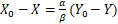 ・・・Formula 1
X0: Initial force strength of your side, X: Remaining force strength of your side, Y0: Initial enemy force strength, Y: Remaining enemy force strength, α: Your weapon performance, β: Enemy weapon performance
② Lanchester Second Law
The Second Law assumes large-scale group combat.
Modern internet markets, large advertising strategies, and SNS strategies closely resemble this structure.
- Advantageous for large corporations
- Capital power, advertising power, and organizational strength are important
- Market share becomes a major weapon
- Force strength is overwhelmingly important
In modern markets, companies can approach large numbers of customers simultaneously, making companies with greater force strength more advantageous.
② Formula of the Second Law

X0: Initial force strength of your side, X: Remaining force strength of your side, Y0: Initial enemy force strength, Y: Remaining enemy force strength, α: Your weapon performance, β: Enemy weapon performance
Modern Markets Follow Lanchester’s Second Law
Today’s business world resembles large-scale group combat because of the spread of the internet and mass communication, which is why the Second Law is considered more applicable.When you actually perform the calculations, you can see that under the Second Law, force strength is far more important than weapon performance.
The following graph shows changes in remaining force strength over time. As shown below, the Second Law results in a larger remaining force.
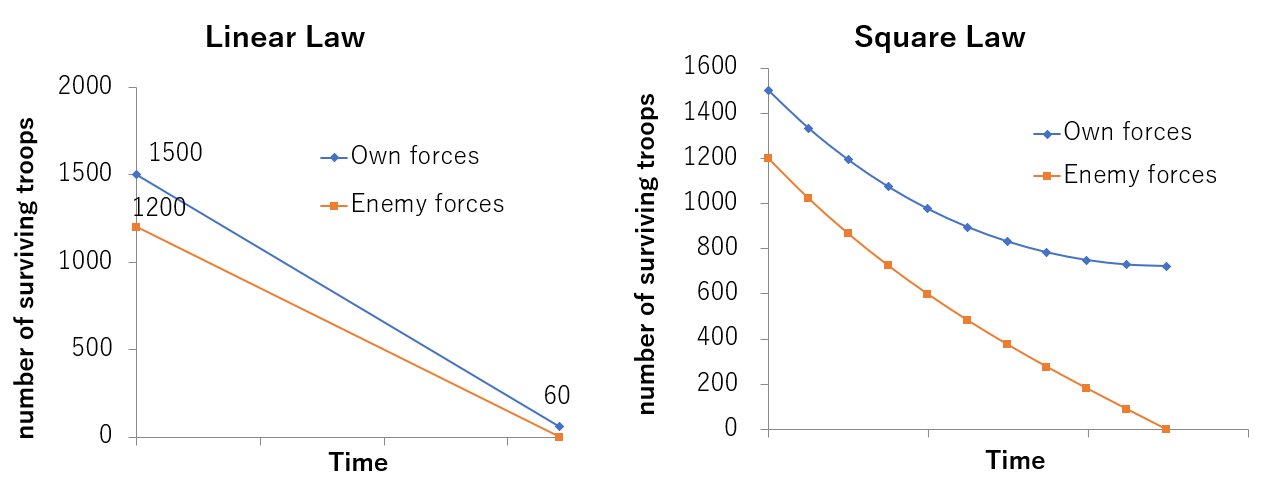
From these results, we can understand the following principles:
・Under the First Law, both force strength and weapon performance are important.
・Under the Second Law, force strength becomes overwhelmingly important.
Therefore, large corporations benefit from strategies based on force strength because they possess greater capital power and larger workforces. On the other hand, small and medium-sized businesses cannot compete with sheer force size, so First Law strategies are more effective. They should aim to fight in markets where they can create one-on-one competition.
In markets governed by the First Law, weapon performance has a stronger influence, meaning smaller companies can still find opportunities to win through superior quality or specialization.
In other words, large corporations should compete with broad market strategies, while small businesses should focus on niche markets where large corporations are less active.
It is disadvantageous for small businesses to compete head-on with large corporations.
Therefore, it is important to bring competition into markets with fewer competitors and create "one-on-one" battles.
Lanchester Strategy for Small Businesses
To compete successfully against large corporations, small businesses must avoid battles based purely on force size.
The following differentiation strategies are important:
- Specialization in a specific field
- Community-based business models
- Focus on niche markets
- High-quality and high-value-added strategies
- Strengthening brand power
- Maximizing customer satisfaction
By competing in markets that large corporations find difficult to enter, even small companies can find opportunities to win.
How to Use the Lanchester Strategy Calculator
- Enter your force strength
- Enter the enemy's force strength
- Enter your weapon performance
- Enter the enemy's weapon performance
- Press the calculate button
Based on the values entered, the app automatically calculates the balance of power according to Lanchester Strategy.
Please use it for business strategy, competitive analysis, and marketing studies.
Who This Web App Is Recommended For
- People who want to learn business strategy
- People studying marketing
- People who want to analyze competitive strategy
- Owners of small and medium-sized businesses
- Entrepreneurs and freelancers
- People interested in business books and management studies
- People who want to understand market share strategies