
Trade Area Analysis Riley & Converse Law Calculator | Free Trade Area Boundary Point Calculation
Where should you open your store?
In retail, restaurants, and service industries, location conditions are one of the most important factors affecting sales.
The "Trade Area Analysis Riley & Converse Law Calculator" is a free WEB app that uses the Riley & Converse Law to calculate the trade area boundary point between your city and a rival city.
You can numerically analyze which areas are more likely to shop in your city and from which point customers are more likely to flow to the rival city.
Use it for store opening strategy, store development, trade area analysis, and marketing analysis.
Click here for instructions on how to use the "Riley & Converse Law Calculator"
What Is Riley & Converse Law?
Riley & Converse Law is a trade area analysis theory used to calculate the trade area boundary point between two cities.
A trade area boundary point means:
- Areas closer than this point → customers are more likely to shop in your city
- Areas farther than this point → customers are more likely to shop in the rival city
Using this theory, you can numerically analyze:
- Which areas become your store's trade area
- The competitive balance between cities
- Which city has the advantage
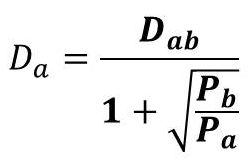
This app calculates the distance Da between your city and the trade area boundary point.
Cities located closer than distance Da are more likely to shop in your city.
The following diagram illustrates the relationship between the three cities.
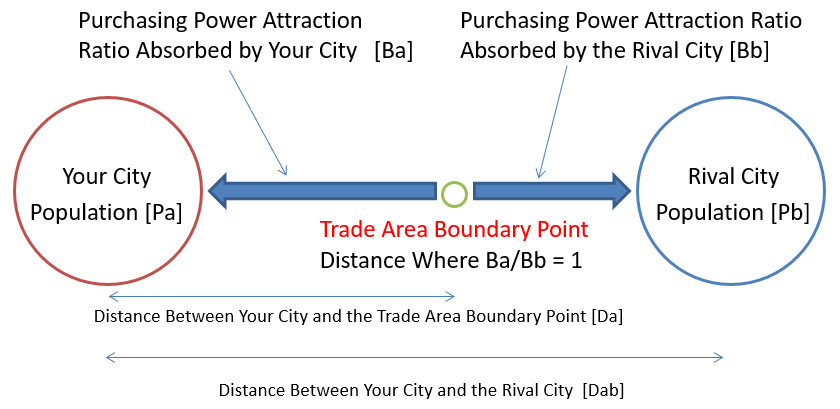
The idea behind Riley & Converse Law is that cities with larger populations have stronger shopping attraction power, while shorter distances make it easier to attract purchasing power.
The calculation formula is shown below.
The Concept Behind Riley & Converse Law
This theory is based on the idea that:
- Cities with larger populations are more attractive shopping destinations
- Closer cities are more likely to be used by customers
In other words, larger cities attract customers more easily, while customers become less likely to travel as distance increases.
Therefore, the balance between population size and distance becomes an important factor in determining trade areas.
2. What You Can Learn with Riley & Converse Law
This website allows you to calculate the distance Da between your city and the trade area boundary point using Riley & Converse Law. Cities located closer than distance Da are more likely to shop in your city, while people living farther than Da are more likely to shop in the rival city.
Will nearby cities shop at your store?
If they are located closer than the trade area boundary point, there is a possibility they will shop at your store.
The closer the distance, the stronger the purchasing attraction becomes.
Therefore, having nearby cities with strong purchasing power creates better location conditions.
When opening a store, location conditions are especially important.
Even if the service is slightly poor, a good location can still generate strong sales.
On the other hand, even excellent products and services may fail if the location is poor.
Location conditions are one of the most important factors when starting a business.
This application allows you to numerically measure whether the city where you want to open a store is advantageous or disadvantageous compared to surrounding cities.
What This Calculator Can Do
- Calculate the trade area boundary distance Da
- Analyze which areas become your store's trade area
- Compare competitiveness with rival cities
- Evaluate advantages of candidate store locations
- Create reference materials for location strategy and trade area analysis
- Learn marketing analysis
Areas closer than distance Da are expected to shift purchasing behavior toward your city, while areas farther away are expected to shift toward the rival city.
Where Riley & Converse Law Is Used
- Shopping mall location analysis
- Restaurant store opening strategies
- Trade area analysis for convenience stores and drugstores
- Franchise expansion
- Intercity competition analysis
- Marketing strategy planning
Why Is the Trade Area Boundary Point Important?
In retail businesses, sales depend heavily on how many customers can be attracted.
Important factors include:
- How many customers can be attracted from nearby cities
- Whether customers will be lost to competing cities
- How far the trade area can expand
Using Riley & Converse Law allows you to make location decisions based on data rather than intuition.
Why Location Conditions Determine Business Success
If location conditions are favorable, customer acquisition becomes easier even if the service has some weaknesses.
On the other hand, no matter how excellent your products or services are, attracting customers becomes difficult if the location is poor.
Therefore, it is extremely important to numerically analyze:
- Which city to open a store in
- Which areas are advantageous
- How large the gap with competitors is
Riley & Converse Law is widely used as a representative theory for conducting trade area analysis.
Recommended For
- People considering opening a new store
- Store development managers
- Retail and restaurant business owners
- Marketing professionals
- Students learning trade area analysis
- People researching business strategy
Calculate Trade Area Boundary Points for Free!
Simply enter population data and distances between cities to easily analyze trade area boundary points.
Use it for store opening strategy, location analysis, and trade area analysis.