
Trade Area Analysis Riley's Law Calculator | Free Retail Gravitation Law Calculation Tool
Where should you open your store?
For retail businesses, restaurants, and service industries, location is one of the most important factors affecting sales.
The "Trade Area Analysis Riley's Law Calculator" is a free web app that uses Riley's Law (Retail Gravitation Law) to easily analyze whether your city or a rival city is more likely to attract customers.
Based on population size and the distance between cities, you can calculate which city is more likely to attract customers (purchasing power) from an intermediate city.
Use this tool for store expansion strategy, retail development, and marketing analysis.
Click here to learn how to use the "Trade Area Analysis Riley's Law Calculator"
What is Riley's Law?
Riley's Law is a trade area analysis theory that measures how strongly two cities attract customers from an intermediate city located between them.
It is also known as the Retail Gravitation Law.
This theory is based on the following concepts:
- Larger cities attract more customers
- Closer cities are more convenient and easier to visit
- The effect of distance increases exponentially (distance squared)
In other words, larger cities have stronger commercial attraction, but customer attraction decreases as distance increases.
Therefore, the balance between population size and distance is critical in trade area analysis.
This calculator estimates how strongly two cities attract customers from an intermediate city located between them.
Your target city and the rival city compete to attract customers (purchasing power) from the intermediate city. The relationship among these three cities is illustrated below.
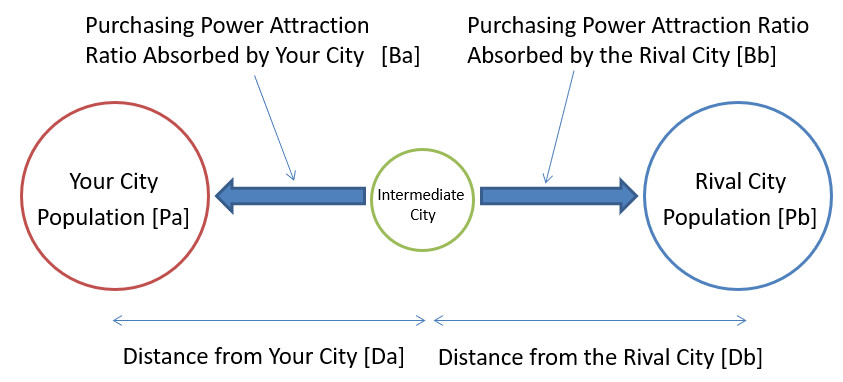
The customer attraction power of your city and the rival city is proportional to population size and inversely proportional to the square of distance. This is the core idea behind Riley's Law. Larger cities are more attractive shopping destinations, while shorter distances improve accessibility and increase purchasing attraction. Since distance is squared, distance has a very strong impact on sales attraction.
The formula is shown below.
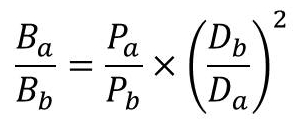
According to Riley's Law, customer attraction is determined by the following conditions:
- Proportional to city population
- Inversely proportional to the square of distance
This means:
- Larger population → Easier to attract customers
- Shorter distance → Easier for customers to visit
The effect of distance is especially significant. Even a small increase in distance can greatly reduce customer attraction power.