Attribute Listing Method|An Idea Technique for Analyzing Product Features
“I want to improve an existing product…”
“I want to create new value by fixing product weaknesses…”
In such cases, the “Attribute Listing Method” is a highly effective idea-generation technique.
The Attribute Listing Method is a process of breaking down the attributes (features) of a product or service in detail and generating new ideas by modifying or improving those attributes.
Because it focuses on thoroughly analyzing existing products, it is especially useful for product improvement and new concept development.
What is the Attribute Listing Method?
The Attribute Listing Method is a technique where you list all attributes (features and characteristics) of a product or service and generate ideas by analyzing and modifying them.
For example:
- Material
- Shape
- Color
- Function
- Usage
- Image/Perception
By breaking these down in detail, you can explore improvements and new possibilities.
The more detailed the analysis, the easier it becomes to discover new concepts.
How to Use the Attribute Listing Method
- Define the theme or problem to solve
- List the attributes of the existing product
- Consider improvements for each attribute
- Generate new combinations or modifications
- Organize ideas into feasible concepts
The key point is:
“Break down attributes as finely as possible.”
More detailed analysis leads to more innovative ideas.
Example Using a Free Template
The theme here is “origami.”
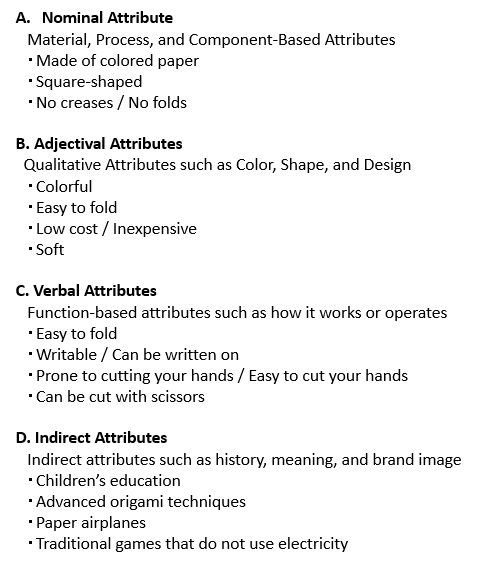
The more detailed the analysis, the more new ideas you can generate, so try to break things down as finely as possible.
Types of Attributes
The Attribute Listing Method mainly analyzes the following types of attributes:
A. Noun-based Attributes
Physical components such as materials and structure.
- Material
- Parts
- Structure
- Manufacturing method
- Size
B. Adjective-based Attributes
Characteristics such as color, shape, and properties.
- Lightweight
- Soft
- Round
- Transparent
- Premium feel
C. Verb-based Attributes
Functions and actions.
- Foldable
- Washable
- Stretchable
- Glowing
- Portable
D. Indirect Attributes
Image, culture, history, and meaning.
- Traditional
- For children
- Luxury image
- Futuristic
- Japanese-style
Example: A New Concept for Origami
Let’s consider a “new origami product.”
| Attribute | Content |
|---|---|
| Material | Paper |
| Property | Weak to water |
| Shape | Thin |
| Function | Foldable |
| Image | For children / Japanese culture |
Now focus on the attribute:
“Weak to water”
What if we consider:
- What if it were made water-resistant?
- What if it could be used in the bath?
- What if it could be reused multiple times?
This leads to ideas such as:
- Waterproof origami
- Bath-time origami set
- Reusable silicone origami
These become completely new product ideas.
Features of the Attribute Listing Method
- Strong for product improvement
- Enables deep analysis of existing products
- Helps identify weaknesses
- Generates practical ideas
- Suitable for invention and innovation
- Easy for beginners to use
Benefits of the Attribute Listing Method
- Helps identify product issues
- Makes it easier to create new concepts
- Supports differentiation from competitors
- Useful for product planning
- Reduces missed perspectives in ideation
- Organizes ideas logically
Who is it for?
- Product developers
- People improving existing products
- Inventors and innovators
- Planners and strategists
- New business developers
- Problem-solving thinkers
Detailed Attribute Breakdown is the Key
The success factor is:
“How detailed you can break down the attributes.”
The more detailed the analysis, the easier it becomes to find improvements and new possibilities.
Even everyday assumptions may hide valuable ideas.
Free Template Available
A free PDF template is available to help you immediately apply the Attribute Listing Method.
Feel free to use it for product development, invention, planning meetings, and new business ideas.
Attribute Listing Method Template Download