
"Lanchester Strategy Calculator App"
User Guide
How to Use
This page explains how to use the web app "Lanchester Strategy Calculator App".
First, enter the following four parameters.
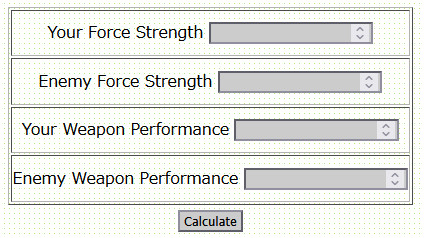
These parameters are labeled as "Number of Troops" and "Weapon Performance."
In business management, troop numbers can be interpreted as the scale of capital resources such as
sales volume,
organizational strength, and
number of employees.
On the other hand, weapon performance can be interpreted as
technical capability,
performance advantage, and other aspects related to product quality.
Please enter numerical values for each parameter. If no value is entered or non-numeric characters are used, an error will occur.
After entering the values, click the "Calculate" button to see the results.
(Result Page)
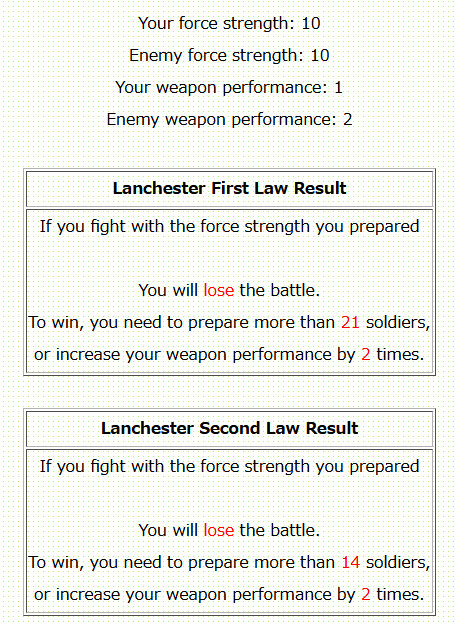
At the top of the result page, the values you entered will be displayed. Using the Lanchester equations, the app will determine whether you can win under the given conditions.
The Two Laws of Lanchester Strategy
Lanchester Strategy consists of two laws.
The first is the Lanchester Linear Law, which assumes one-on-one combat between individuals.
The second is the Lanchester Square Law, which assumes group combat between large forces.
The Linear Law can be understood as a duel or one-on-one battle.
The Square Law represents large-scale combat where one combatant can attack multiple opponents, similar to machine-gun warfare.
In the modern business world, where the internet and mass communication dominate, competition is often considered to follow the Square Law.
The formulas are shown below.
① Linear Law
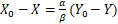 ・・・Equation 1
X0: Initial strength of your side, X: Remaining strength of your side, Y0: Initial strength of the enemy side, Y: Remaining strength of the enemy side, α: Weapon performance of your side, β: Weapon performance of the enemy side
② Square Law

X0: Initial strength of your side, X: Remaining strength of your side, Y0: Initial strength of the enemy side, Y: Remaining strength of the enemy side, α: Weapon performance of your side, β: Weapon performance of the enemy side
Modern Markets Follow the Lanchester Square Law
In today's business environment, the spread of the internet and mass communication has created conditions similar to group warfare, which is why the Square Law is considered dominant.
If you actually perform the calculations, you will notice that under the Square Law, troop strength becomes far more important than weapon performance.
The following graph shows the change in remaining troop strength over time.
As shown below, the Square Law leaves a larger surviving force.
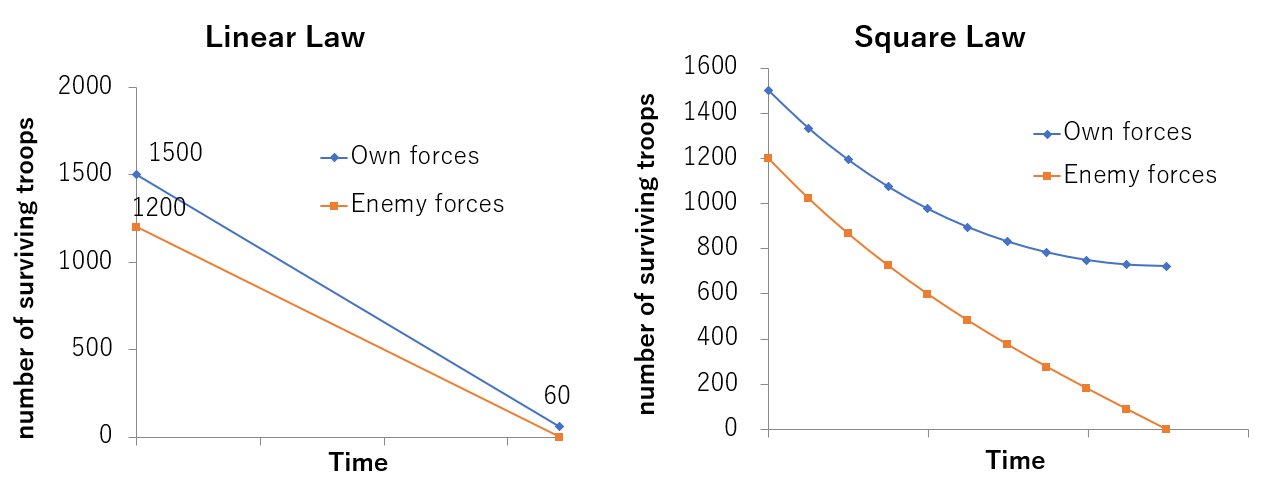
From this result, the following principles can be observed.
・Under the Linear Law, both troop strength and weapon performance are important.
・Under the Square Law, troop strength becomes overwhelmingly important.
Therefore, large corporations, which possess greater capital resources and larger workforces, are better suited for strategies based on the Square Law, where sheer scale dominates the competition.
On the other hand, small and medium-sized businesses cannot easily compete with large-scale resources, so strategies based on the Linear Law are often more effective.
They should aim to fight in markets where one-on-one competition is possible.
Because weapon performance has relatively greater impact under the Linear Law, companies can find opportunities for success through superior quality or specialization.
In other words, large corporations tend to pursue broad, all-direction strategies, while smaller companies should compete in niche markets that large corporations are less likely to enter.
You can access the web app "Lanchester Strategy Calculator App" here.
Go to the Lanchester Strategy Calculator App