
"CPV Analysis Calculation App"
User Guide
How to Use
This page explains how to use the WEB app "CPV Analysis Calculation App".
CPV analysis is a method for analyzing the relationship between
Cost, Volume, and Profit.
By entering the following values:
Sales Revenue,
Unit Price,
Variable Costs,
Fixed Costs, and
Target Profit,
you can calculate the following information.
①Break-even Sales Revenue: The sales amount at which neither profit nor loss occurs.
②Break-even Ratio: The lower the value, the more resistant the business is to declining sales.
③Safety Margin Ratio: A higher value indicates greater business stability.
④Sales Revenue Required to Achieve the Target Profit
⑤Break-even Sales Quantity: The sales quantity required to reach the break-even point.
Now let’s explain how to use the app.
First, enter the following five parameters.
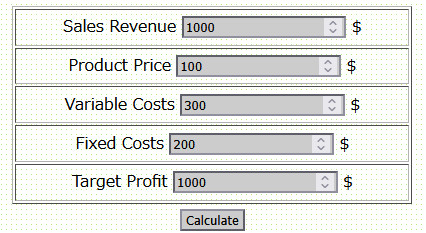
The meaning of each parameter is as follows.
① Sales Revenue: Actual sales revenue
② Unit Price: Selling price per product
③ Variable Costs: Costs that increase in proportion to sales quantity
④ Fixed Costs: Costs that remain constant regardless of sales quantity
⑤ Target Profit: Desired profit goal
After entering the numbers, click the "Calculate" button to display the result.
(Result Page)
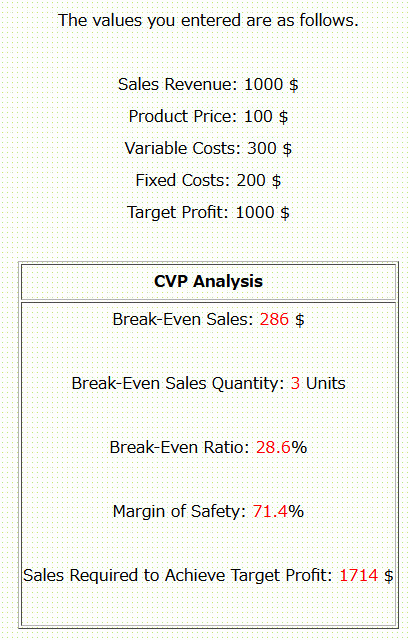
Next, we will explain each calculation result in detail.
① Break-even Sales Revenue
This calculates the sales revenue at the break-even point where neither profit nor loss occurs.
The formula is shown below.
Break-even Sales Revenue = Fixed Costs ÷ (1 − Variable Costs ÷ Actual Sales Revenue)
If actual sales revenue falls below the break-even sales revenue, the business operates at a loss.
If sales exceed this value, the business generates profit.
Therefore, it is important to maintain sales above the break-even point through effective business activities.
② Break-even Ratio
A lower break-even ratio indicates stronger resistance to declining sales.
The formula is shown below.
Break-even Ratio [%] = Break-even Sales Revenue ÷ Actual Sales Revenue × 100
Every business experiences ups and downs.
When sales decline, profits also decrease.
However, businesses with a low break-even ratio can still maintain relatively strong profitability even during sales downturns.
Generally, businesses with low production costs tend to have a lower break-even ratio.
If the ratio is high, efforts should be made to reduce production costs and improve efficiency.
③ Safety Margin Ratio
A higher safety margin ratio indicates a safer and more stable business condition.
The formula is shown below.
Safety Margin Ratio [%] = (Actual Sales Revenue − Break-even Sales Revenue) ÷ Actual Sales Revenue × 100
A high safety margin means the business has stronger resistance against declining sales.
To improve the safety margin, businesses should increase sales revenue or lower the break-even point.
④ Sales Revenue Required to Achieve the Target Profit
Setting a profit target is important in business management.
This calculation determines the sales revenue required to achieve the desired target profit.
The formula is shown below.
Sales Revenue Required to Achieve Target Profit
= (Fixed Costs + Target Profit) ÷ (1 − Variable Costs ÷ Actual Sales Revenue)
⑤ Break-even Sales Quantity
This calculates the quantity of products that must be sold to reach the break-even point.
The formula is shown below.
Break-even Sales Quantity = Fixed Costs ÷ {Unit Price × (1 − Variable Costs ÷ Actual Sales Revenue)}
You can access the WEB app "CPV Analysis Calculation App" here.
Go to the CPV Analysis Calculation App